
Some movie feel cozy because they have warm colours, beautiful houses, slow music, and people drinking tea near a window.
Usagi Drop has some of that.
But it also a movie that begins with a funeral, introduces us to a six-year-old girl nobody wants to take responsibility for, and then gives her to a single man who has absolutely no idea how to raise a child.
Also, Rin is technically Daikichi’s aunt.
So, yes.
One of the weirdest plots.
And somehow, one of the coziest.

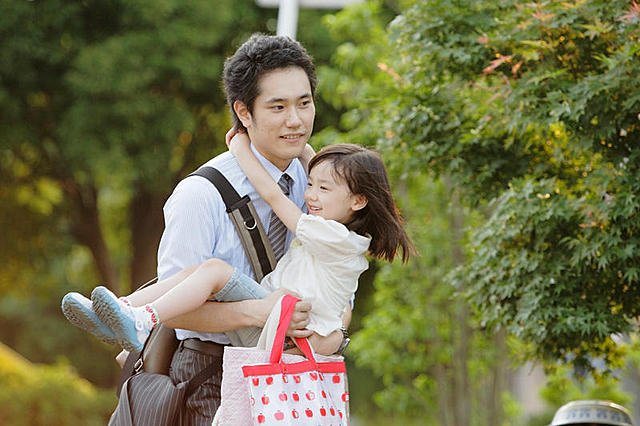
Usagi Drop is a 2011 Japanese movie about Daikichi, a single officer worker who decides to take care of Rin after the death of his grandfather. Daikichi is not prepared, or particularly good with children. Rin is quiet, careful, and still trying to understand whether the adults around her can be trusted.
The movie does not turn their relationship into a series of dramatic speeches.
It lets them take time.
And somewhere between the morning rush, nursery pickups, meals, train journeys, and Daikichi constantly trying to figure out what he is supposed to do, they slowly begin to feel like a family.
So, here are seven things that make Usagi Drop such a cozy movie.
#1 The opening scene in the field
The movie begins with Daikichi and Rin moving through a field.
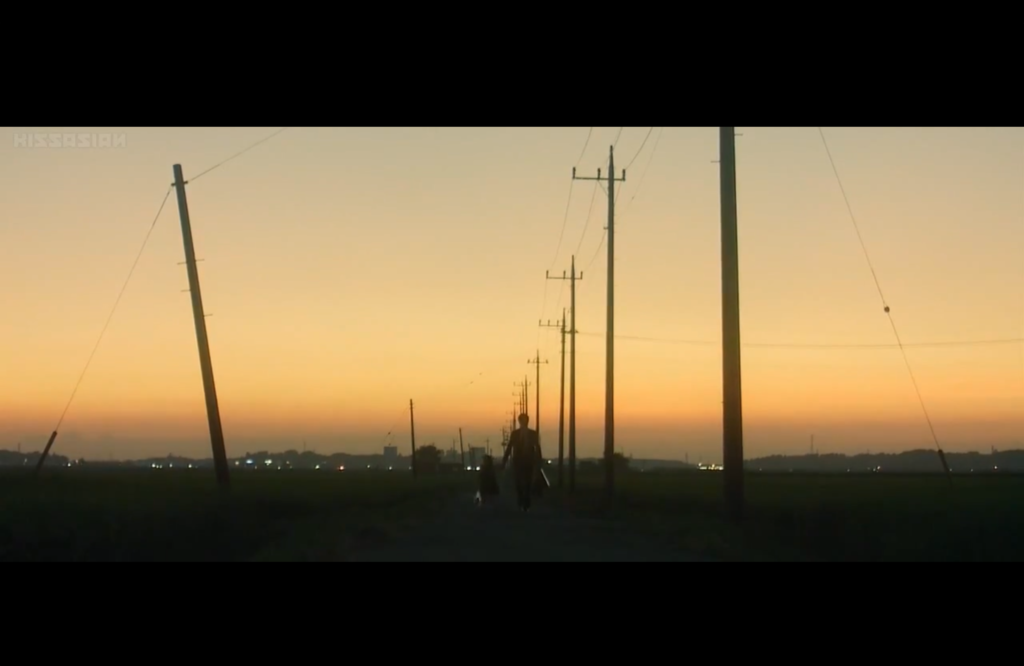
Before we properly understand who they are or what their relationship is, we see them together in the wide, green, almost dreamlike place.
There is something immediately peaceful about it.
The field feels open and quiet. Rin is small against the landscape, while Daikichi moves around her with the awkward energy, most probably showing his delimna of taking the right choice or not.
It is a simple scene, but it gives us the emotional mood of the entire movie.
#2 Japan itself feels like part of the movie
One of the loveliest things about Usagi Drop is the way it shows Japan.
We see quiet contryside landscapes, traditional family homes, green open spaces, busy streets, trains, offices, nurseries, and the daily movement of Tokyo.

The movie moves between two different versions of Japan.
There is slower countryside, where the family gathers and where Daikichi first meets Rin. Then there is the city, where their actual life together begins.
Both are beautiful in completely different ways.
The countryside has space, silence, and memory. While, Tokyo has routine, crowds, schedules, and movements.
And because the movie came out in 2011, it also captures a particular version of city life. Smartphones and digital life do not dominate every scen. People are still looking at each other, waiting at stations, speaking face to face, and figuring things out without searching for a parenting tutorial over the internet every five minutes.
Daikichi could have used one.
But still.
The movie makes everyday Japan feel warm without trying to turn every location into a postcard. The beauty comes from how naturally people live inside these places.
#3 The ordinary Tokyo routine
A lot of Usagi Drop is simply about daily life.
Daikichi wakes up.
He gets Rin ready.
He goes to work.
He worries about childcare.
He rushes to pick her up.
He comes home tired.
Then he does it again.
On paper, this does not sound exciting.
But that is exactly why it feels cozy.
The film does not treat ordinary life as something that needs to be skipped before the real story begins. The routine is the story.
We watch Daikichi’s life slowly change around Rin. His schedule is no longer only his own. He has to think about school timings, meals, clothes, work hours, and whetehr he will reach nursery before it closes.
These small responsibilities begin to create the shape of their home.
There is something comforting about watching a life become organised around care.
Not perfectly organised. Daikichi is mostly surviving. But organised enough.
#4 Daikichi learning how to become a parent
Daikichi does not know how to be a parent.
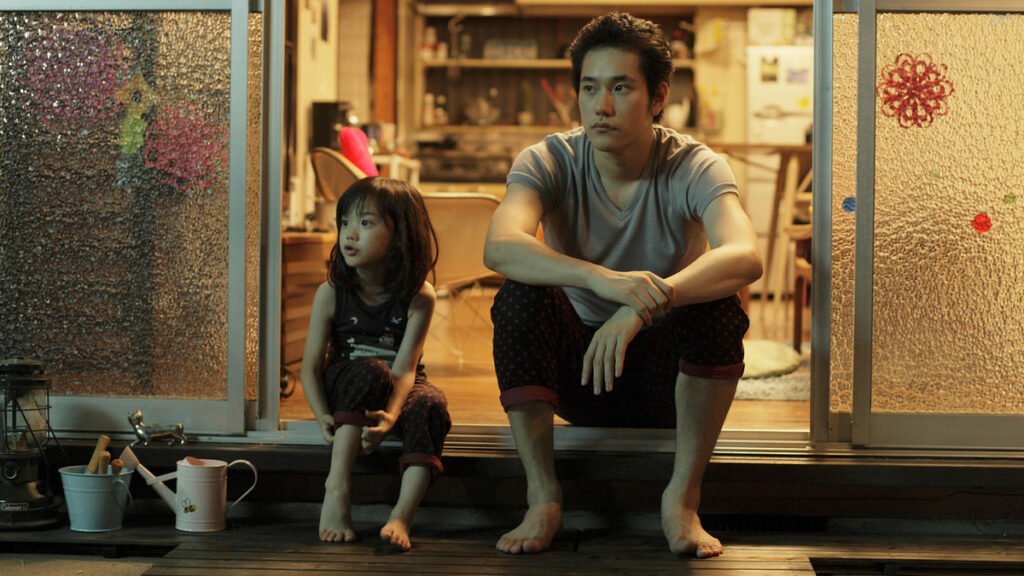
And the movie does not pretend that caring intentions automatically give someone parenting skills.
He has to learn everything.
He has to understand Rin’s routines, find childcare, adjust his work, deal with other parents, and notice the things children may not directly say.
This is one of the reasons Daikichi feels real.
He does not suddenly become a wise father figure after taking Rin home. He remains confused for most of the movie.
But he is willing to figure it out. That is the important difference.
Parenting in Usagi Drop is not shown as having all the answers. It is shown as paying attention, making adjustments, asking questions, and returning the next day to try again.
#5 Daikichi shows love through action
Daikichi is not very good at expressing himself.
He does not constantly tell Rin how much he cares about her. He does not give emotional speeches or create big father-daughter moments.
He shows love through action.
He changes his working life.
He learns her routine.
He makes sure she is not along.
He shows up.
That is his language.
daikichi may not know how to say, “You are important to me,” but he begins arranging his life as if she is.
And maybe that says more.
Because words can happen in one moment. Showing up has to happen repeatedly.
Again.
And again.
And again.
There is no “I love you, Daddy” kind of lovey-dovey scene in the movie.
Their bond is more empathetic than sentimental.
#6 The movie never forces the emotion
The biggest reason Usagi Drop feels cozy is that it never tries too hard to become a cozy movie.
It does not fill every scene with soft music and emotional dialogue.
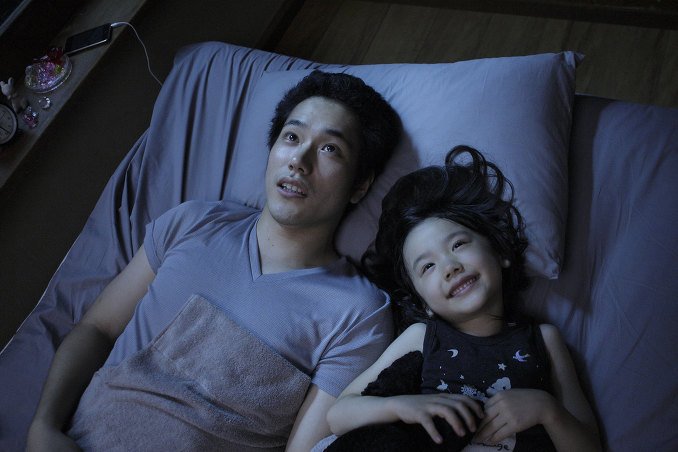
It does not keep reminding us that Daikichi is making a sacrifice. Not also, it use Rin only as a cute child.
The movies simply allows them to live together.
Many movies are about finding someone. Usagi Drop is more about someone staying.
#7 Daikichi keeps zoning ouot
Daikichi is not shown asa permanentaly alert and emotionally mature adult.
Sometimes he daydreams; he just zones out in the middle of everything, and his mind creates strange, exaggerated versions of what is happening around him.
These scenes are funny, but they also make him feel more real.
So, what makes Usagi Drop such a cozy movie?
I think Usagi Drop is a cozy because it does not create comfort out of a perfect life.
Daikichi is not prepared to become a parent. Rin is not immediately ready to trust another adult.
But they figure it out.
Slowly.
The beautiful countryside, the everyday Tokyo streets, the trains, the nursery runs, the meals, the daydreaming, and Daikichi’s permanently confused expression all make the movie pleasant watch. But underneath all of that, the real comfort comes from consistency.
Daikichi shows up.
That is how he loves.
Frequently asked questions about Usagi Drop
Where can I watch the Usagi Drop movie?
At the time of writing, a full English-subtitled version of the movie can be found on Dailymotion.
However, streaming uploads can disappear, and I could not confirm whether that upload is officially licensed. So please check the availability in your region before watching.
The important part is to search for the 2011 live-action Japanese movie, also called Bunny Drop. There is also an anime with the same name, which can make the search slightly confusing.
Should I watch the Usagi Drop anime or read the manga?
My honest recommendation?
Watch the live-action movie and stop there.
The anime covers the earlier, wholesome part of the story and does not reach manga’s infamous later development. So the anime itself is not as strange as the complete manga.
But for Cozy Watchlist, I would still recommend the movie.
The manga, however?
Do not read it.
I wrote NOT.
DO NOT BECOME CURIOUS. DO NOT SEARCH FOR THE ENDING. DO NOT THINK, “HOW STRANGE COULD IT POSSIBLY BECOME?”
It can.
Let Daikichi reman a lovely, awkward guardian in your memory and continue with your life.
Sometimes stopping at the right place is also a form of self-care.
Hahaha.
Are there any other movies like Usagi Drop?
The closest movie I can think of is the Chinese film Lighting Up the Stars.
It follows Mo Sanmei, a rough and slightly lost mortician who unexpectedly begins taking care of an orphaned girl named Xiaowen.
The circumstances are different, and the movie deals more directly with death and grief, but the emotional centre feels similar. Once again, we have a man who is not prepared to care for a child and a child who does not immediately trust him.
Their relationship grows through arguments, daily routines, mistakes, and actions rather than perfect emotional speeches.
It is funny, emotional, a little chaotic, and purely cozy.
So, after watching Usagi Drop, watch Lighting Up the Stars next.